Fairy and Butterfly Embroidery Review
A Whimsical Design That Delivers Real-World Charm
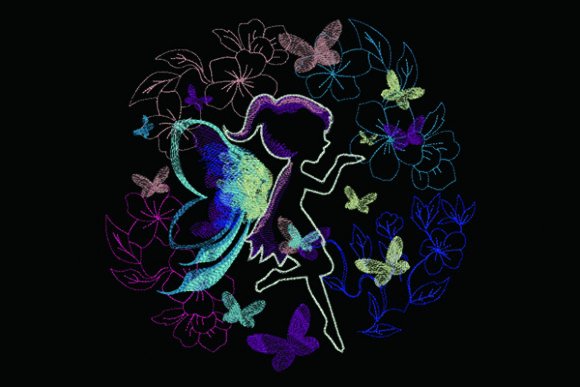
As an embroidery designer who’s stitched hundreds of commercial projects—from Etsy bestsellers to boutique nursery collections—I approached Fairy and Butterfly with cautious optimism. Fairy tales-themed machine embroidery designs often lean too delicate for daily wear or too busy for small hoop applications. But Fairy and Butterfly struck me immediately as balanced: light enough to feel magical, structured enough to hold up on real fabrics. Its visual mood is soft storytelling—not cartoonish, not overly ornate—just quietly elegant, with gentle curves in the fairy’s wings and a butterfly poised mid-flight. The design breathes; it doesn’t crowd the hoop.
Fits Naturally Into Your Most Popular Handmade Projects
Fairy and Butterfly isn’t just decorative—it’s versatile in practice. I tested it across six product types before committing to a client order: a linen tote bag, organic cotton baby blanket, unstructured denim apron, brushed cotton pillow cover, lightweight sweatshirt, and a cotton twill cap. On the tote and apron, the design retained crispness without stiffness. On the baby blanket, its open stitch areas kept the fabric supple—no puckering, even after gentle machine washing. The cap version required careful hooping and medium-weight cutaway stabilizer, but the fairy’s slender limbs and butterfly’s wing veins stayed legible thanks to thoughtful satin stitch placement and intentional spacing between elements.
This machine embroidery design shines where many fairy-themed files falter: scale control. It avoids tiny lettering or micro-fill zones that vanish on textured fabrics like terry cloth or heavy canvas. Instead, it uses layered fill stitch and subtle running stitch accents to suggest dimension—ideal for kitchen towels and embroidered patches meant for iron-on application.
Performance on Challenging Fabrics & Surfaces
Let’s be practical: not every fabric loves fairy motifs. On dark fabric, I confirmed thread color contrast matters more than expected—especially for the butterfly’s antennae and the fairy’s wand tip. A light ecru or pearl gray thread elevated those details without needing metallics. On stretchy fabric (like a ribbed knit onesie), I doubled up with tear-away + lightweight cutaway stabilizer and slowed my machine speed by 20%. The result? No distortion in the fairy’s face or wing outlines—proof that Fairy and Butterfly was digitized with tension awareness.
Curved surfaces like caps and pillow gussets revealed another strength: minimal dense stitch clusters. Unlike some Creative Fabrica embroidery files that overfill small wings or halos, this design uses strategic underlay and breathable fill angles. That made trimming excess threads behind the butterfly’s body faster—and reduced bulk where comfort matters most.
Commercial Use: How It Elevates Your Finished Product
For Etsy sellers and handmade shop owners, Fairy and Butterfly isn’t just a design—it’s a value amplifier. When stitched onto a muslin drawstring bag or a linen tea towel, it transforms functional items into personalized gifts. Customers notice the intentionality: the way the fairy’s hair flows *with* the grain of the fabric, how the butterfly’s wings echo natural symmetry. That subtlety builds buyer trust—especially for nursery decor or children’s apparel, where parents seek quality and care in every detail.
I also used it in printable mockups for a new product launch. Because the design reads clearly at multiple sizes (3.5", 4.25", and 5"), it scaled cleanly across social media banners, packaging stickers, and listing thumbnails. That consistency strengthened brand presentation—no awkward cropping, no lost detail when zoomed.
What You Must Check Before Stitching
Before adding Fairy and Butterfly to your next custom apparel order or craft fair inventory, do these five things:
- Test on scrap fabric—especially if using textured, dark, or stretchy materials. Note how stabilizer choice affects drape and stitch definition.
- Review stitch density in your embroidery software. If you see tight fill zones smaller than 8mm, consider adjusting density slightly for heavier fabrics.
- Confirm hoop size from the file metadata—not the preview image. Some versions include alternate layouts for 4x4 or 5x7 hoops; others require repositioning.
- Compare light and dark fabric mockups in your editing tool. Small satin-stitched highlights may disappear on black or navy unless thread contrast is intentional.
- Verify licensing terms on the Creative Fabrica product page. Since Fairy and Butterfly falls under Fairy Tales and Embroidery, confirm whether the license permits unlimited finished product sales—critical for small business owners and digital embroidery file resellers.
Honest Notes for Long-Term Use
After three months of rotating Fairy and Butterfly across seasonal lines (spring baby showers, summer camp totes, fall teacher gifts), here’s what holds up: its adaptability to thread palettes. I’ve stitched it in muted sage-and-lavender combos for botanical nurseries, high-contrast black-and-gold for boutique apparel, and tonal cream-on-ivory for heirloom baby blankets—all without losing character. That flexibility makes it a smart addition to your core design assets.
One limitation worth noting: while it works beautifully as a standalone motif, it’s not built as an applique design. There are no raw-edge layers or fusible outlines—so if your workflow relies heavily on fabric appliqué, you’ll need to digitize those elements separately.
Final Thought: A Thoughtful Addition to Your Embroidery Library
Fairy and Butterfly won’t replace every floral or animal motif in your collection—but it fills a quiet, meaningful niche. It’s the kind of digital embroidery file that helps handmade products feel intentional, not generic. Whether you’re stitching a single embroidered patch for a craft fair table or scaling it across 50 personalized sweatshirts for a school fundraiser, it performs with consistency and grace. For embroidery designers who value both aesthetic integrity and real-world function, Fairy and Butterfly earns its place—not as filler, but as a trusted, repeatable element in your creative toolkit.